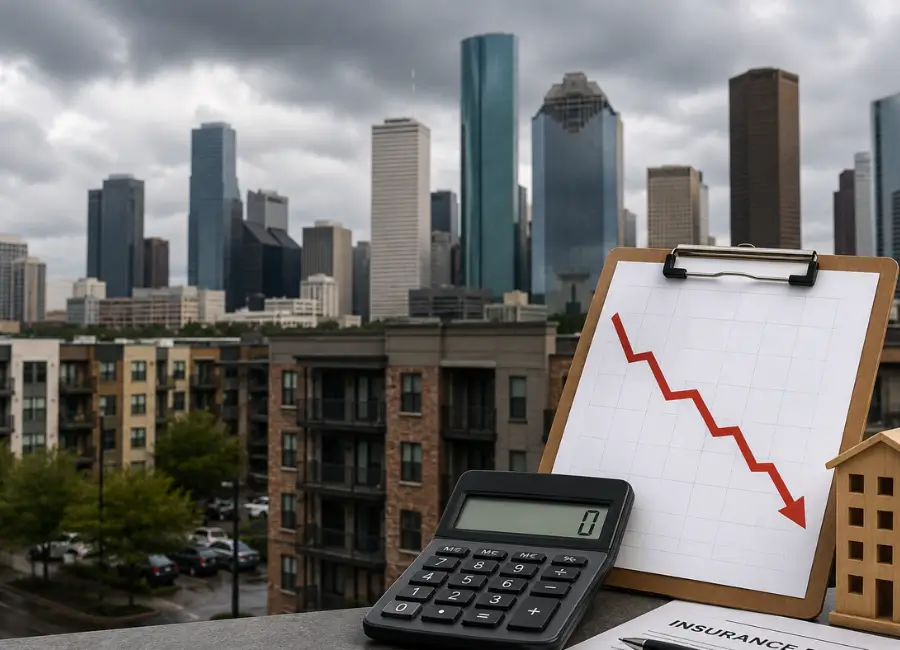
A single line item on the operating statement has quietly become the biggest swing factor in Sun Belt multifamily deals, and it isn't debt service. Insurance costs have suppressed apartment values by 3.6% nationwide since 2019.
In Houston, that number is 11.1%. Insurance makes up just 8% of total operating expenses on the average multifamily property, yet it has driven 17% of all expense growth over the same period.
For investors who spent the last two years modeling rate risk, cap rate movement, and construction cost inflation, this is the variable almost nobody built into their underwriting.
The Line Item Nobody Underwrote For
A recent survey of apartment investment firms representing 1.6 million units found that property insurance rates rose 26% on average in a single year.
That is not a one-time correction. It is the result of carriers pulling out of high-risk markets, reinsurance getting more expensive globally, and a run of catastrophic weather events, from the Texas freeze in 2021 to major hurricanes along the Gulf Coast, that reset how underwriters price risk everywhere.
Carriers have responded by raising deductibles for the majority of policyholders and tightening what they will actually pay out in a claim.
Coverage that used to be a rounding error on the pro forma is now a line that can move a deal from viable to dead, and it moves faster than rent growth can offset it.
You can also read: Insurance Is Now the Line Item That Kills Deals in 2026.
Houston and the South Central Squeeze
Texas, Oklahoma, and the broader south central region have seen multifamily values fall roughly 7.8% due to insurance alone, with Houston as the hardest hit metro at 11.1%.
Gulf Coast exposure to hurricanes, combined with memories of the 2021 freeze that burst pipes and flooded units across the region, has made underwriters price Houston risk more conservatively than almost anywhere else in the country.
For operators and lenders active in Houston, this changes the math on acquisitions that looked fine eighteen months ago.
A deal that cleared underwriting on last year's insurance quote may not clear it this year, and buyers who are not stress testing renewal premiums two and three years out are underwriting yesterday's market.
You can also read: Multifamily Starts Hit 10-Year Low: What It Means for Sun Belt Investors.
Florida's Preview of What Is Coming
Florida offers a preview of where exposed markets can end up. Values there are down 6.8% on the same insurance drag, with Jacksonville down 9.6%.
In parts of the state, premiums have more than doubled in a two-year span.
Florida got there first because its catastrophe exposure is the most severe in the country, but the underlying mechanics, thinner carrier pools, higher reinsurance costs, and insurers exiting the market entirely, are not unique to Florida.
They are showing up wherever climate and construction risk intersect.
That is the real lesson for Gulf Coast and coastal Sun Belt investors. Florida did not experience a fluke. It experienced the repricing that other exposed metros are now catching up to.
You can also read: The Power Grid, Not Zoning, Is Now the Real Constraint on Industrial Land.
Why DFW, Austin, and Phoenix Are Not Immune
Dallas-Fort Worth, Austin, and Phoenix sit further from coastal catastrophe risk and have not seen value erosion on the scale of Houston or Florida.
Population growth, job creation, and rent fundamentals in all three markets remain some of the strongest in the country. But insurance pricing is no longer purely local.
When carriers pull back in California and Florida after wildfire and hurricane losses, they raise rates and tighten terms across their entire book, and that book includes properties in Texas and Arizona that never filed a weather-related claim.
Hail is also a growing factor across North Texas and the broader Sun Belt interior, and insurers are increasingly separating wind and hail coverage from base property policies with its own deductible structure.
Investors who assume DFW, Austin, and Phoenix are insulated from this trend because they are inland are underestimating how connected the insurance market has become.
You can also read: $875B in CRE Debt Matures in 2026: Here is the Opportunity.
How Smart Operators Are Underwriting Around It
The operators pulling ahead are the ones treating insurance as a due diligence category, not a closing cost.
That means getting a firm quote before going to contract instead of using a placeholder number, checking which carriers actually write policies in a given metro and asset class, and understanding a property's construction type and roof age before assuming coverage will be available at all.
Some are self-insuring a portion of the risk through higher deductibles to bring premiums down, others are investing in wind mitigation and roof retrofits on older assets specifically to qualify for better terms, and a growing number are structuring deals with insurance cost reserves built into the capital stack from day one instead of treating a premium spike as a surprise at renewal.
The investors buying well right now are often the ones who can price this risk accurately while sellers and less sophisticated buyers are still working off outdated assumptions.
That gap, between what a property costs to insure and what most people assume it costs, is where the next round of Sun Belt opportunities is going to come from.
You can also read: Interest Rates & Real Estate in 2026: How Smart Investors Are Adapting.
Where the Real Edge Comes From
None of this is information you can get from a spreadsheet alone.
Knowing which carriers are actually writing new business in Houston this quarter, which contractors do wind mitigation retrofits without a six-month wait, and which lenders have adjusted their debt service coverage assumptions for rising premiums- that knowledge lives in relationships, not reports.
This is exactly the gap REF (Real Estate Forum) exists to close.
Across our DFW, Austin, Houston, and Phoenix chapters, investors, brokers, lenders, attorneys, CPAs, and insurance specialists are already comparing notes on exactly this problem, often before it shows up in a renewal notice.
If insurance is reshaping how you underwrite your next deal, the fastest way to get ahead of it is talking to people already living it in your market.
Join REF and connect with the professionals who are solving this in real time.