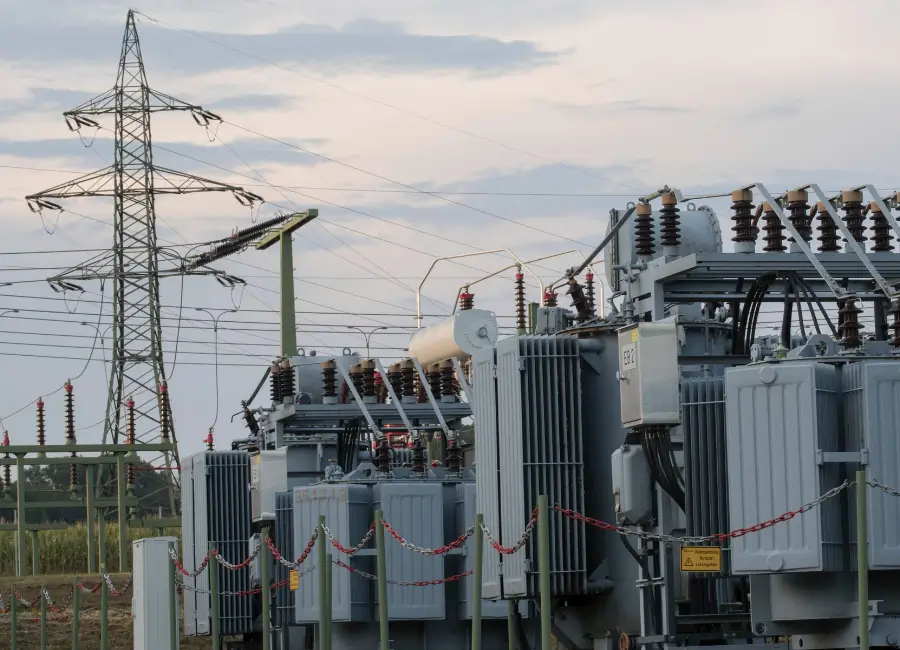
For twenty years, industrial developers worried about land prices, labor availability, and zoning approvals. None of those is the binding constraint anymore. Electricity is.
Roughly 100 gigawatts of new data center capacity is expected to come online between 2026 and 2030, representing an estimated $1.2 trillion in new real estate asset value, and every megawatt of it is competing for the same substations and transmission capacity that traditional industrial and logistics users need to run their buildings.
Power Replaced Land as the Scarce Input
Across the country, the binding constraint on industrial site selection has quietly shifted from acreage and access roads to electrical capacity.
Data centers now capture roughly 31% of global private real estate investment in recent quarters, and they need power in volumes that dwarf a typical distribution center or manufacturing plant.
When a hyperscaler shows up looking for 50 or 100 megawatts, it can absorb the available grid capacity for an entire submarket, leaving little headroom for the warehouse, cold storage, or light manufacturing tenant who used to be the default user of that land.
This is not a niche problem anymore. It shows up in interconnection queues that stretch out to four years in some utility territories, in substation upgrade costs that get passed through to whoever is next in line, and in industrial land prices that are increasingly priced off proximity to power infrastructure rather than proximity to highways or population centers.
The old site selection checklist still matters, but it is no longer the first filter.
Why the Demand Curve Looks Nothing Like the Last Cycle
The scale of the shift is what makes this different from prior industrial supercycles.
Projections point to 35-45 gigawatts of U.S. data center power demand by 2030, roughly double 2024 levels, with as much as 200 gigawatts of new AI-driven demand layered on by the end of the decade.
At the same time, more than 100 gigawatts of existing generation capacity is expected to retire over a similar window.
That combination, demand doubling while supply shrinks, is why utilities are rationing interconnection capacity and why developers are treating a signed power agreement as more valuable than a signed lease.
For anyone who underwrote industrial deals in the last cycle on the assumption that power was a utility hookup you ordered in month three of construction, that assumption no longer holds.
Power availability now needs to be confirmed before a site is optioned, not after.
What This Means for Traditional Industrial, Not Just Data Centers
The ripple effect lands hardest on conventional industrial users who are not the ones driving the demand spike but are competing for the same limited capacity.
Logistics operators, manufacturers, and cold storage users are increasingly finding that the parcels with adequate power are the ones a data center developer already has under contract or is actively bidding on.
That competition is pushing rents up in power-rich submarkets and pushing conventional industrial development toward secondary and tertiary markets where grid capacity is more predictable, even if those markets carry weaker demographics or logistics fundamentals.
Developers who once treated a rail spur or highway interchange as their strongest site amenity are now leading with a letter from the utility confirming available capacity.
That letter has become the new proof of concept for a deal, more persuasive to a lender than a market study.
You can also read: $875B in CRE Debt Matures in 2026: Here is the Opportunity.
Why Sun Belt Markets are Ground Zero
DFW, Houston, Phoenix, and Austin are all seeing this play out in real time.
These metros combine the population growth and logistics demand that make conventional industrial attractive with the land availability and lower operating costs that make them prime data center targets.
That overlap means direct competition for the same substations, the same transmission upgrades, and in some cases the same parcels.
Phoenix in particular has become a flashpoint, with utility capacity constraints now factoring into site selection conversations as heavily as water availability once did.
DFW and Houston are seeing similar dynamics play out around key substations, where a single large power commitment can effectively take a submarket off the table for smaller industrial users for years.
Austin's growth has made it a target for both data center and traditional logistics demand simultaneously, compressing the available power capacity even faster.
You can also read: Multifamily Starts Hit 10-Year Low: What It Means for Sun Belt Investors.
How the Operators Ahead of This are Responding
The developers who are not getting caught flat-footed are treating power the way they used to treat entitlements, as a diligence item to resolve before closing, not during construction.
Bring-your-own-power arrangements, on-site generation, and modular microgrids are moving from experimental to standard practice for large users who cannot wait years in an interconnection queue.
Some developers are now securing power capacity years ahead of a confirmed tenant, essentially banking megawatts the way they used to bank entitlements.
For conventional industrial investors, the opportunity is in the markets everyone else is overlooking because they lack a marquee data center story.
Secondary submarkets with underused grid capacity are becoming more attractive precisely because the competition for power has not arrived there yet.
You can also read: Interest Rates & Real Estate in 2026: How Smart Investors Are Adapting.
Where REF Fits In
Power availability is not something you figure out by reading a market report.
It is something you learn from the developer who just spent two years fighting an interconnection queue, the broker who knows which submarkets still have headroom, and the utility-side contact who can tell you what is actually available before you option a parcel.
That is the kind of intelligence that moves fastest through relationships, not spreadsheets.
REF's (Real Estate Forum) chapters bring together the developers, brokers, and capital sources who are already navigating this shift, sharing what they are learning before it becomes public knowledge.
If you are underwriting industrial deals without a power strategy, the market has already moved past you.
Join REF and connect with the people solving this problem in your market right now.